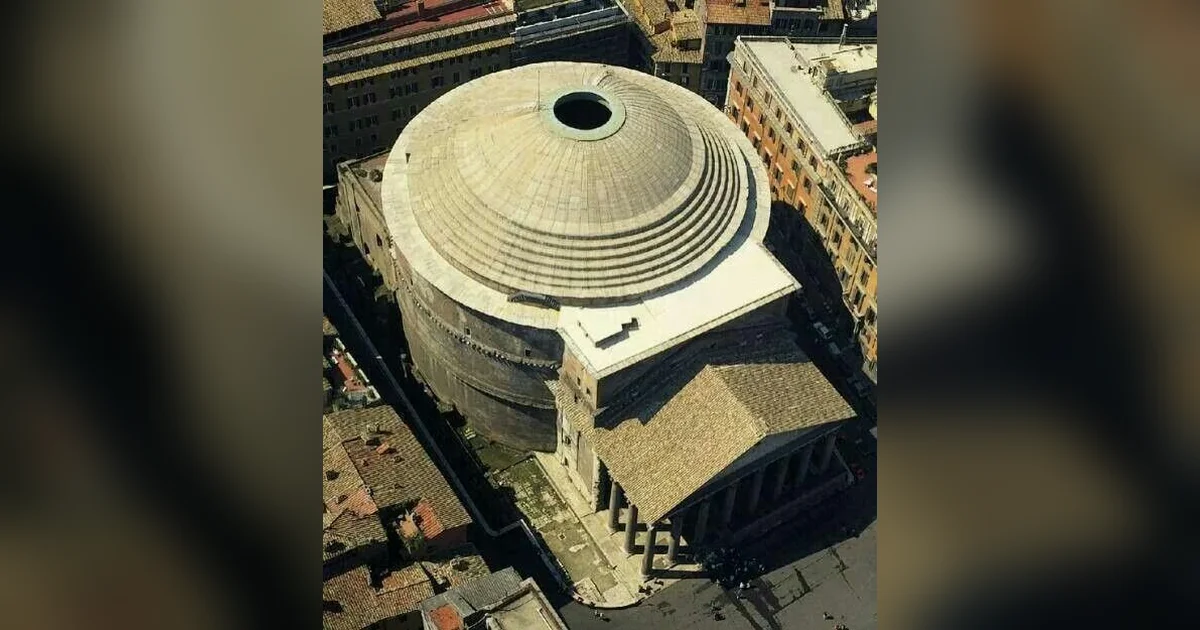
A temple does not choose to have rain fall on its own floor. The Pantheon's oculus is open because the dome's top cap would reflect sound straight back onto the emitter, so it was removed and the opening became the interface to the outside medium.
Our case
The oculus of the Pantheon is open because the system needs it open. A dome is a reflector. With the emitter at the center of the floor, sound travels up to the dome, reflects from a band of its surface, and returns to the platform level, where the working Reactors stand in a ring around the +Source. The very top of the dome is the one place that cannot be used: sound that strikes it comes straight back down onto the emitter and interferes with the emission itself. So the cap is removed, and the energy that would have returned leaves through the opening into the open medium. The oculus is the interface between the system and the medium outside it. A temple does not choose to have rain fall on its own floor. A system that has to exchange energy with the air above it does.
What is documented
- The building. The Pantheon in Rome was completed around 125 CE under the emperor Hadrian. Its dome measures 43.3 metres across and is the largest unreinforced concrete dome in the world. The height from the floor to the opening is the same as the interior diameter, so a sphere fits inside the room: a cylinder of 21.65 metres topped by a hemisphere of the same radius.
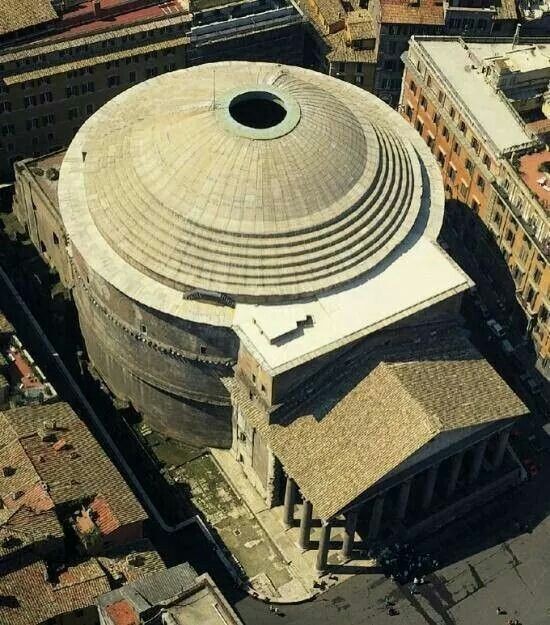
- The opening. At the apex is the oculus, about 8.2 metres across (other sources give up to 9). It is open to the sky. The dome carries five rings of 28 coffers, and on the outside, in your own photograph, stepped rings run up the lower half of the dome and a smooth cap rises above them to the rim of the opening.
- The rain comes in. Rain falls through the oculus onto the pavement. The floor is shaped to shed it, with drainage holes that feed a hidden Roman drain system, which is still working. The builders did not tolerate the opening. They planned for the water it lets in.
- The usual explanations. The oculus is said to lighten the crown of the dome, to light the interior, and to join earth and sky, with a sunbeam that reaches the bronze doors on 21 April.
Why the usual explanations do not explain an open oculus
Each of them explains a hole in the crown. None explains a hole that is left open to the weather. An opening that only lightens the crown can be glazed or capped, and later domes, Florence among them, put a lantern over it. Light can come in through windows. A symbol of heaven does not need rain to fall on the floor of the sanctuary, and it certainly does not need a drainage system built to carry the rain away. A building meant only for worship would have closed the opening. The one function that requires an open path to the outside air is an exchange with the medium outside, and that is the function the Component describes.
Why a dome at all
The emission leaves the +Source in every direction. The Tunnel opening covers only a small part of those directions. A wave that travels straight from the +Source into the Tunnel and onto a working Reactor is caught, and that Reactor responds. Every emission that travels toward a part of the room the Tunnel entrance does not cover is a missed opportunity: it goes nowhere and harnesses nothing.
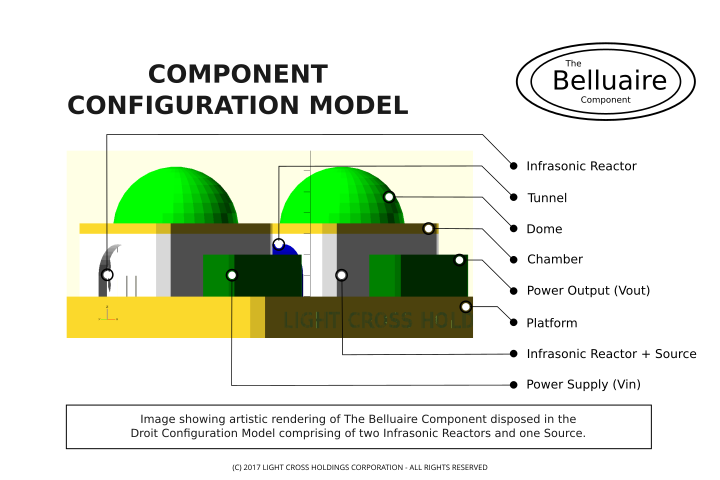
The dome turns the miss into a return. It reflects a portion of those emissions back to the Tunnel opening, and the Tunnel channels them to the next Reactor. The curvature of the dome is constant, so the surface is the same in every direction, like the emission itself. No direction is favored. However the emission leaves, the surface answers it in the same way, and that evenness is what we mean by focus (Figure 3 shows the Tunnel at the wall).
What the opening does in the Component
In the Component the Dome gathers and redirects the field, the +Source drives its Resonator and establishes the key signature, and the other Reactors stand around it. The Component also draws on the accumulated atmospheric infrasonic potential, which lives in the atmosphere and not in the room. A system like that needs a doorway to the air.
The geometry fixes where the doorway goes. Put the emitter on the floor at the center of the Pantheon and trace where its sound lands after one reflection from the dome (Figure 2).
- The cap returns the sound onto the emitter. Rays that strike the dome near the axis come back down onto the +Source or right beside it. At the edge of the oculus the first reflection already lands only about 9 metres from the emitter. The oculus is 8.2 metres across and spans about 11 degrees either side of the axis. It removes exactly the zone whose reflections would fall on and around the +Source.
- The band delivers to the platform. From halfway along the arc, 45 degrees up from the springline and about 37 metres above the floor, to the edge of the oculus, the first reflections land on the floor from about 12 metres out to the wall, and up the wall to the springline. That is a ring at platform level.
- The lower dome is not used. Below that halfway mark the reflections go back up into the dome and never reach the platform. This is where the stepped rings sit on the outside.
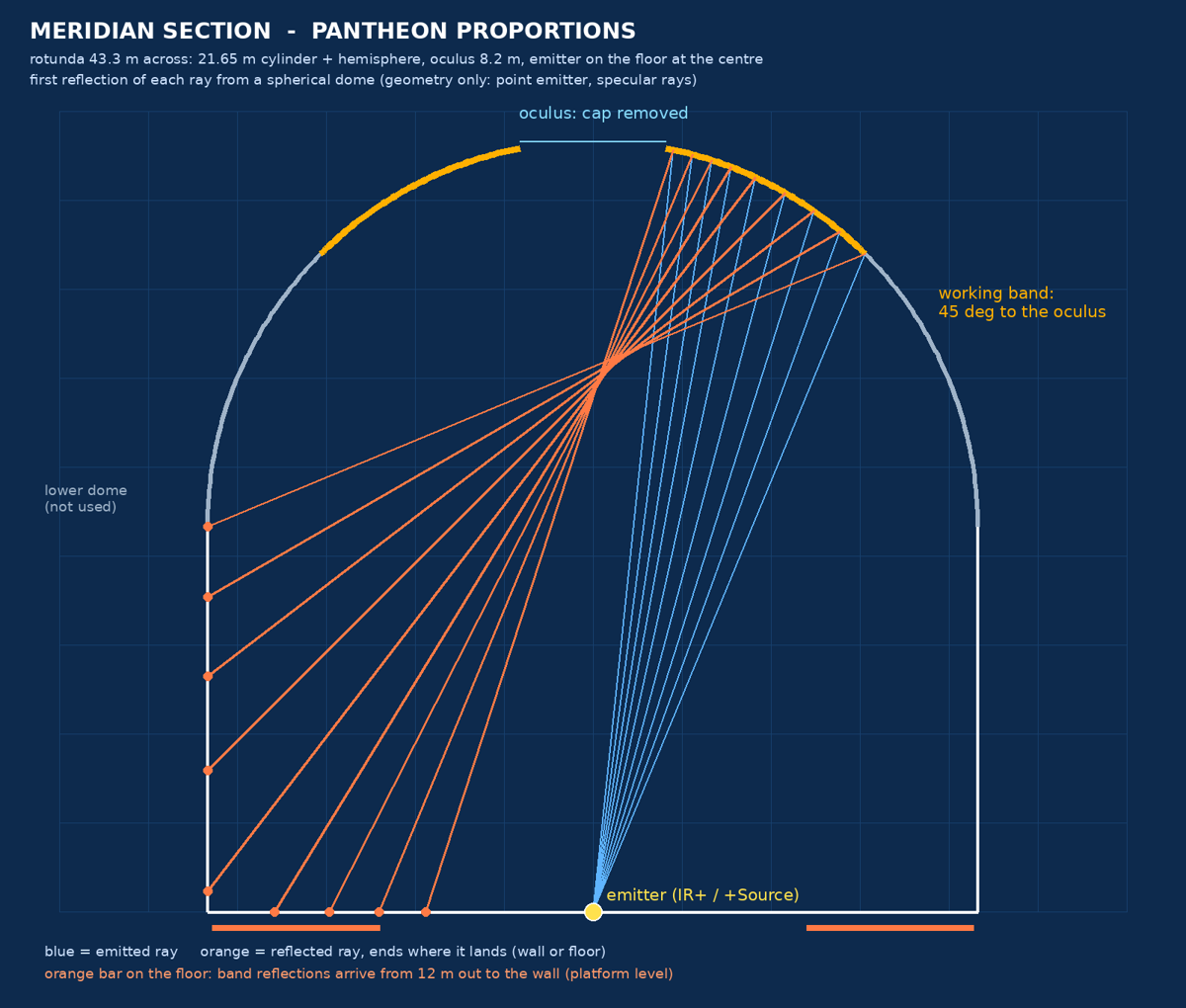
So the Pantheon has the three zones the argument needs: a lower dome that does no reflecting, a band that sends the sound to the ring, and a top cap that is gone. The opening sits exactly where the one unusable region of the dome would have been.
The ring and the Tunnel
In the Component the rooms are joined by the Tunnel. The book describes it as the connecting passage between rooms, running along the Platform with a semi-circular ceiling, and it carries the acoustic field from room to room, so that the Source can drive the others through the connecting passages. In the Component Configuration Model (Figure 3) the Tunnel sits against the wall, at platform level. The band’s reflections in the Pantheon arrive in the same place: on the floor from 12 metres out to the wall, and at the foot of the wall. The ring and the Tunnel occupy the same ground.
The same arrangement elsewhere
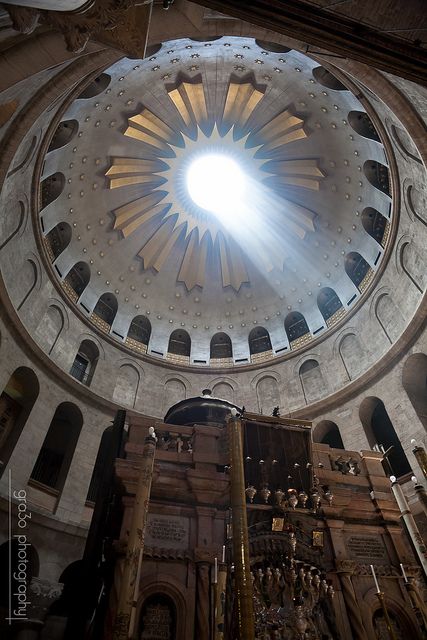
The Pantheon is not the only domed room with the working point on the axis under the opening. In the Rotunda (Anastasis) of the Church of the Holy Sepulchre in Jerusalem the oculus stands directly above the Aedicule, the structure at the center of the room, and it is the main source of direct light in the basilica (Figure 4). The pattern is the same: a central structure at floor level, an opening at the apex on the axis above it, and the walls and galleries around.
What would test this
- An impulse sounded from the center of the floor, with microphones on the ring from 12 metres out to the wall, to measure what actually arrives, and when.
- The same impulse measured at the zone under the oculus edge, to compare what returns to the emitter with the ray trace.
- The floor and its drains, surveyed against the ring: where the drain holes sit, and how the slope of the floor relates to the 12-metre line.
- The opening’s width against the cap it removes, measured on the dome as built.
For the Dome, the +Source and the activated medium, read Understanding the Belluaire Component. For other structures in this series, see Hagia Sophia and What Crowns a Dome.