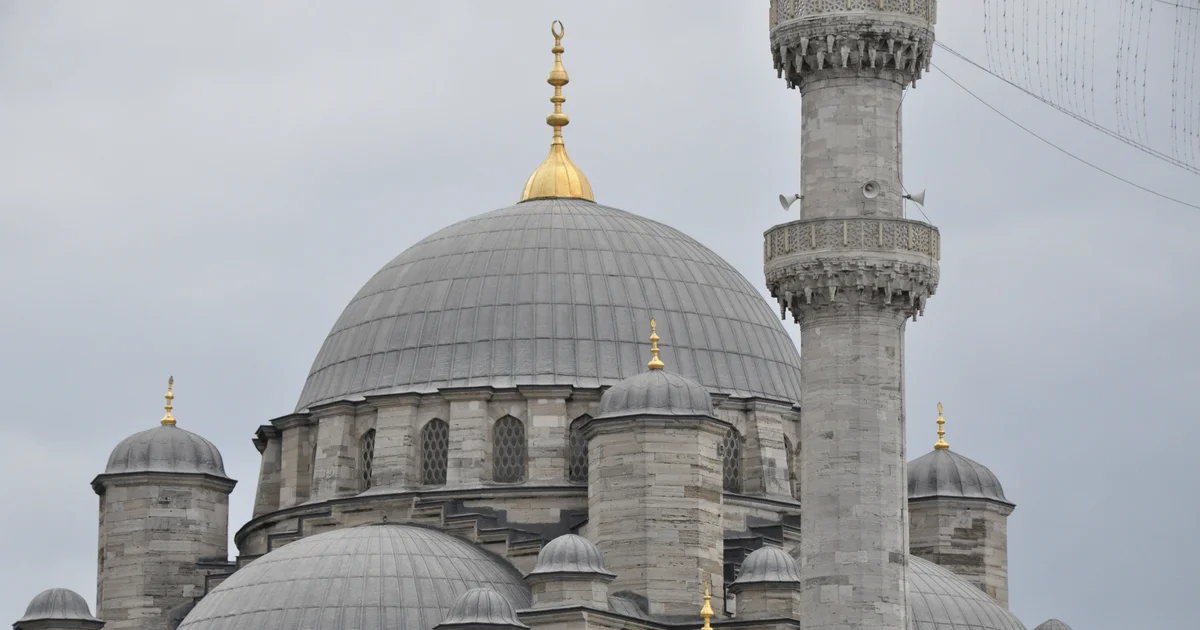
A ring of smaller domes around a large one is what we would expect if each dome were tuned to a harmonic of the main dome. A hypothesis about the Yeni Cami, and the measurement that would test it.
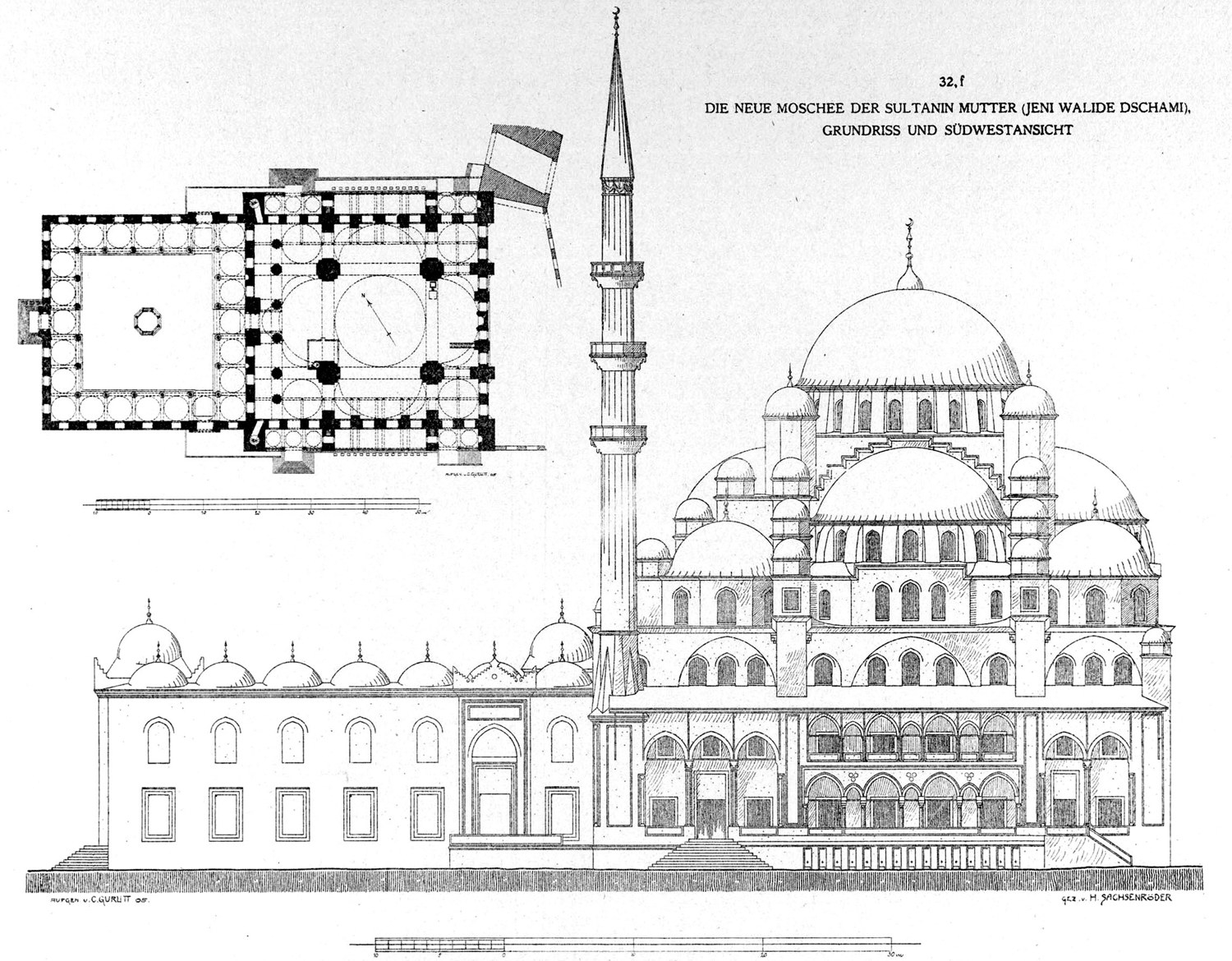
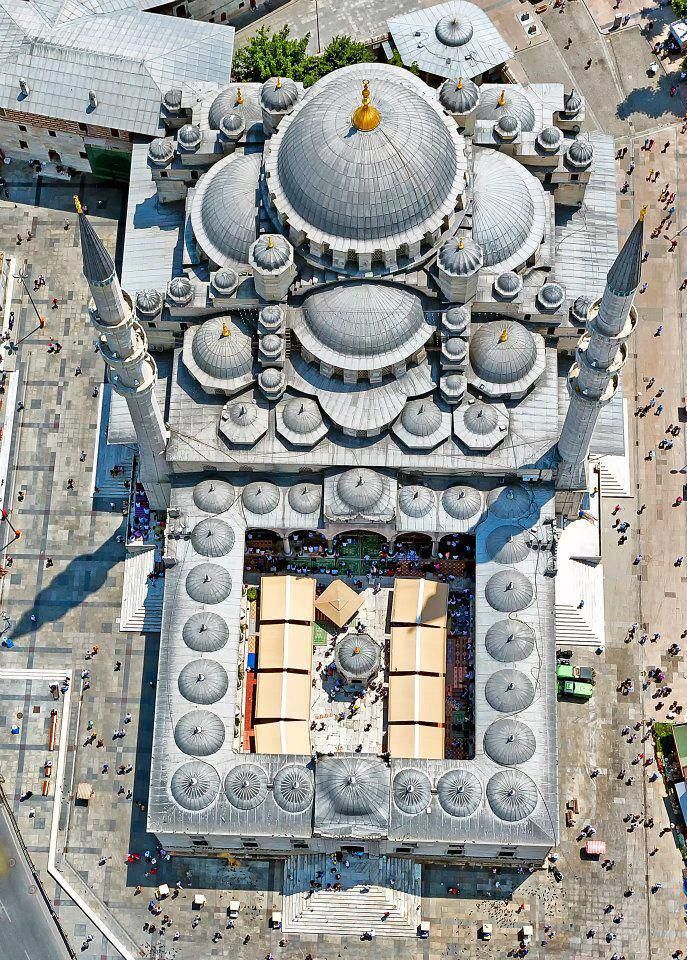
Header photo: Detail of the domes - The New Mosque (Yeni Cami) by Jorge Láscar, 2012, licensed CC BY 2.0. Cropped and resized. Figure 1: plan and elevation by Cornelius Gurlitt, 1912 (public domain). Figure 2: aerial view of the Yeni Cami, as circulated online, photographer not identified.

We hold that the cascade of domes at the Yeni Cami is a bank of resonators: a large dome tuned to a fundamental, surrounded by smaller domes tuned to its harmonics. A smaller enclosed volume resonates at a higher frequency than a larger one, so a ring of small domes around a large one is exactly the arrangement you would build to resonate at harmonics rather than at the fundamental. Our reading comes from the Belluaire Component, whose tuned Infrasonic Reactors respond to a key frequency and its harmonics. The test is simple, and we set it out at the end.
A cascade with more than one acoustic scale
The Yeni Cami, also called the Yeni Valide Sultan Mosque, stands in the Eminonu district of Istanbul, on the Golden Horn at the southern end of the Galata Bridge. It has about sixty-six domes and semi-domes arranged in a pyramid. Its main dome, about 36 m high, is supported by four semi-domes, and the building has two minarets. That visible sequence—from the main dome outward and downward through smaller domes—shows enclosure size stepping down, and resonant frequency steps with it.

In the book Understanding the Belluaire Component, the Dome is described as an enclosure that concentrates acoustic energy toward a focal point. The Belluaire Component is not a dome by itself: it is an operating system in which a Source establishes a key frequency, an activated medium couples tuned Reactors into sympathetic resonance, and Collectors convert the motion of their Loads into electricity. The Component’s dome-focused acoustics matter here because they suggest a way to think about architectural volumes as potential participants in a frequency relationship, rather than simply as shapes seen from outside.
The Component is a designed system and the Yeni Cami is a mosque with its own documented history. They are different buildings carrying the same arrangement: the mosque carries the arrangement the Component calls for, and that this is a pattern we find again and again in the great domed buildings.
The finials, briefly
In the header photograph, the main dome and several of the larger domes around it carry a gilded finial, the main one ending in a crescent, while the smallest domes carry none. What a finial is documented as, and what we suggest the reader weigh about the dome-top, we take up separately in What Crowns a Dome: The Alem, the Apex, and What Changes With Custody. This post stays with the domes themselves and their sizes.
Small domes and the harmonic expectation
The second part of our hypothesis concerns the cascade itself. A smaller enclosed volume resonates at a higher frequency than a larger one. From that relationship, we would expect a ring of smaller domes around a large dome to be a plausible arrangement for resonators tuned to harmonics of the main dome’s fundamental, rather than to the fundamental itself. This is an expectation to measure, not a result we can report for Yeni Cami.
The Belluaire Component helps explain why the harmonic question matters. Its Reactors are tuned to a key frequency, and the system can also couple through harmonics—integer multiples of that key frequency—when those frequencies are present in the activated medium. In architectural terms, the possibility worth examining is whether the main dome and smaller domes have resonant frequencies that form such a relationship. If they do, their differing volumes could be understood as a coordinated set of acoustic scales. If they do not, we are wrong about the harmonics.
Neither outcome can be inferred from the pyramid-like arrangement alone. The dome-and-semi-dome type is generally understood to descend from Hagia Sophia. That shared lineage is exactly why the question remains open: shared lineage could mean shared function or shared fashion, and only acoustic measurement of the actual domes can tell them apart. Our earlier posts considered Hagia Sophia’s dome, including measured reverberation over 10 seconds, and the Shrine of the Book. Here, the focus is a different question: whether the distinct sizes in a cascade form a measurable frequency pattern.
From architectural reading to measurement
No measurement of the resonant frequencies of the Yeni Cami's domes has been published. The missing numbers are the resonant frequency of the main dome and of every small dome. Taking them is the test. The Component shows how enclosure, resonance, tuning and energy conversion fit together, and it tells us what to look for.
The history of the building is clear in outline: construction began in 1597, ordered by Safiye Sultan, mother of Mehmed III, with the architect Davud Aga, an apprentice of Sinan. Work stopped after Mehmed III died in 1603. The unfinished building was damaged by a fire in 1660; Turhan Hatice Sultan, mother of Mehmed IV, resumed the project, and the imperial architect Mustafa Aga completed it in 1663. It was inaugurated in 1665, though sources differ between 1663 and 1665. These facts establish the mosque’s documented context; they do not settle the acoustic question.
The finials on these domes, and what they may mark, are taken up in What Crowns a Dome: The Alem, the Apex, and What Changes With Custody.
The test is specific: measure the resonant frequencies of the main dome and of each small dome, then determine whether they fall at integer multiples of one fundamental. That would let us assess the harmonic expectation directly, rather than infer it from appearance. For the principles behind this reading, see the book Understanding the Belluaire Component and the other structures posts on this site.