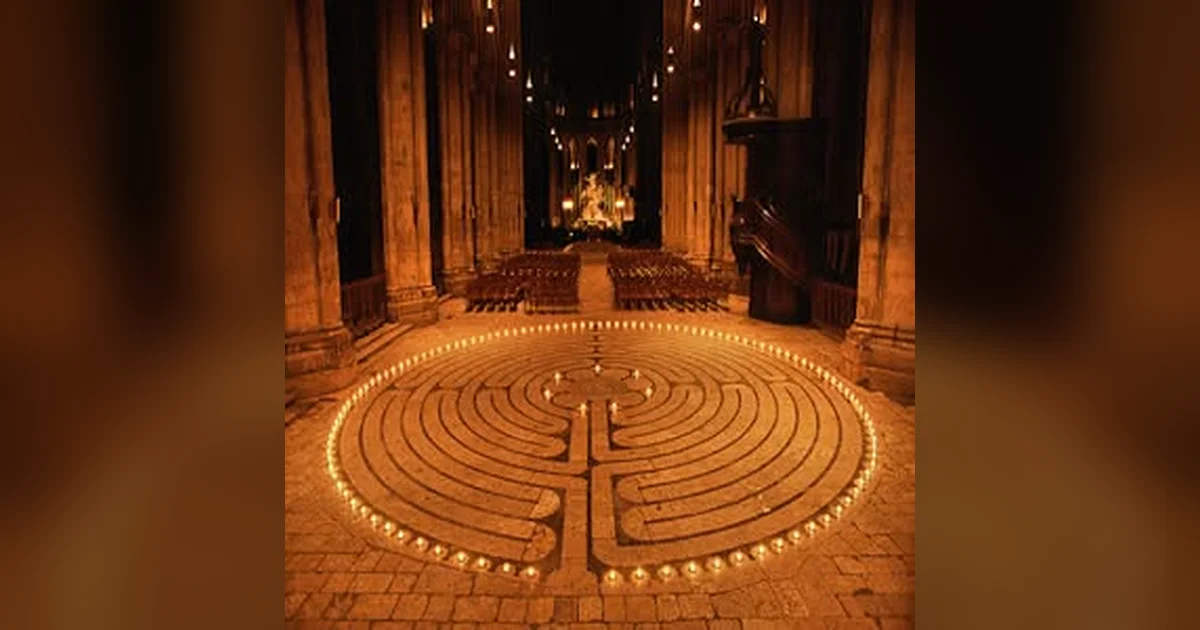
The labyrinth that recurs in churches is a winding: one continuous path in concentric turns around a center, the geometry of the coil that drives the Belluaire Component's ferromagnetic Resonator.
Our case
The labyrinth that recurs in churches and religious motifs is a winding assembly. It is a single continuous path laid in concentric turns around a center, and that is the geometry of the coil the Belluaire Component uses to drive its ferromagnetic Resonator, which stands on the Pedestal at the center. The pavement labyrinth at Chartres is that coil drawn flat. We hold that the pattern survived as a drawing of the part after the part itself was gone.
What the Component requires of its Source
The book states the requirements plainly, and they are geometric:
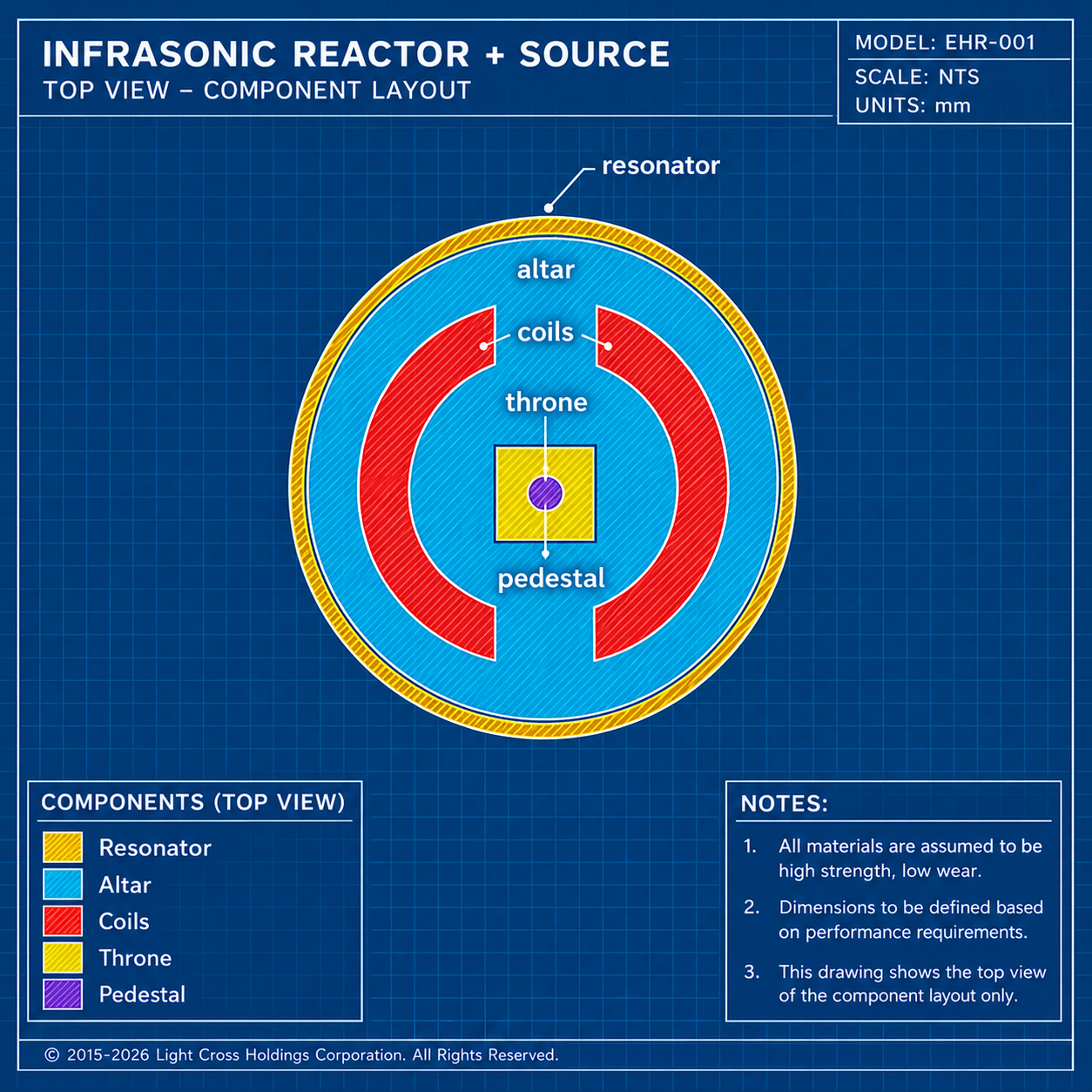
- The Resonator is ferromagnetic. It is suspended on an elastic Pedestal and mounted in the Altar at the Platform level.
- The Source is a pair of complementary semi-circular electromagnetic coils, electronically controlled, embedded in the Altar and flanking the Resonator’s lower section.
- The two coils are energised in alternation. Each pulls the ferromagnetic Resonator toward its own side, first one way and then the other, so the Resonator swings at its natural frequency.
- Everything is arranged around one central axis, with the Resonator and Pedestal at the center and the coils around them.
What the labyrinth is
- Chartres. The labyrinth is set into the floor of the nave of Chartres Cathedral, around 1200 (sources place it between about 1200 and the 1230s), in dark blue and white stones. It has 11 concentric circuits and measures about 13 metres, some 40 feet, across. A six-petaled rosette fills the center, and a ring of lunations runs around the perimeter. One source reports a brass medallion at the center that was melted down during the Napoleonic wars.
- One path. A labyrinth, unlike a maze, has no choices and no branches. A single route leads from the entrance to the center, turning back on itself in half circles at the edges of each circuit.
- The pattern is old in the church. The oldest known church labyrinth is a 4th-century mosaic from the Basilica of St Reparatus at Orléansville, now Chlef in Algeria, with the words Sancta Eclesia in its center. Chartres, Reims and Amiens are named as the grand pavement labyrinths of the Gothic period.
- Most were removed. One source reports a purge of church labyrinths in France in the 17th and 18th centuries, with Chartres, Saint-Quentin and Saint-Omer among those that survived.
The match
A winding is one conductor. A coil is a single continuous conductor with a start and an end, laid in turns around a center. The labyrinth is a single continuous route with an entrance and a center, laid in circuits around a center.
Eleven circuits are eleven turns. The magnetic field of a coil grows with its number of turns. The Source has to move a ferromagnetic Resonator, and the labyrinth supplies the turns.
The half circles are the semi-circular coils. The path turns back in half circles at each end of a circuit. The Source is built of two complementary semi-circular coils. The labyrinth is that pair, wound into one continuous path.
The center is left clear. The coils flank the Resonator’s lower section, and the Resonator and Pedestal take the middle. The labyrinth leaves a rosette at the center, and in at least one case a metal object once stood there.
Put the two drawings side by side. The circle, the central axis, the two semi-circular arcs around a clear center: the top view of the Source and the plan of the pavement describe the same assembly. We hold that the cathedral builders kept the plan of the winding in the floor, where it could be walked, after the working part was gone from beneath the dome.
Suppressed: the face value is the evidence
No document says what the labyrinth is for. None says the pavement is a winding, and none says it is not. The records of this technology were suppressed, and what is left of it is the face value of the form. We read the face value. A single unbranched path, laid in concentric circuits around a clear center, turning back in half circles, is a winding on its face. It sits on the floor of the nave, under the open space of the building, where the Source sits under the Resonator in the Component.
The pattern was also taken out of the churches. Most of the French church labyrinths were removed in the 17th and 18th centuries, and Chartres is one of the few that remain. We hold that what survived is what was left standing: a plan with its purpose removed, repeated in stone and in religious motifs long after anyone was permitted to say what it was.
The research images
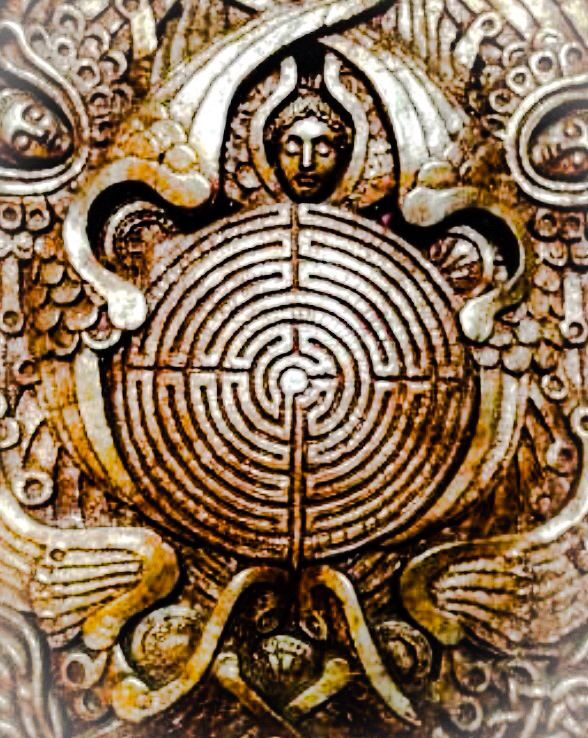
The labyrinths, windings and coil forms gathered for this research are collected on a public board: Bobina, on Cortex. The pavement at Chartres, the reliefs and the recurring motifs are there side by side, so the reader can compare the forms directly.
What would test this
- A survey of the Chartres pavement, and of its center above all, with ground-penetrating radar and a magnetometer, for embedded conductors, metal, or voids shaped like a winding.
- The labyrinth’s total path length and turn count, measured and set against the winding the Source needs to move a Resonator of the book’s proportions.
- The center of the pavement, inspected for a seat, bore or anchor of the kind a Pedestal requires.
- The plan of Chartres overlaid at scale on the top view of the Source, and the same done for the Reims and Amiens plans.
For the parts named here, read Understanding the Belluaire Component. For the other structures in this series, see Hagia Sophia and What Crowns a Dome.