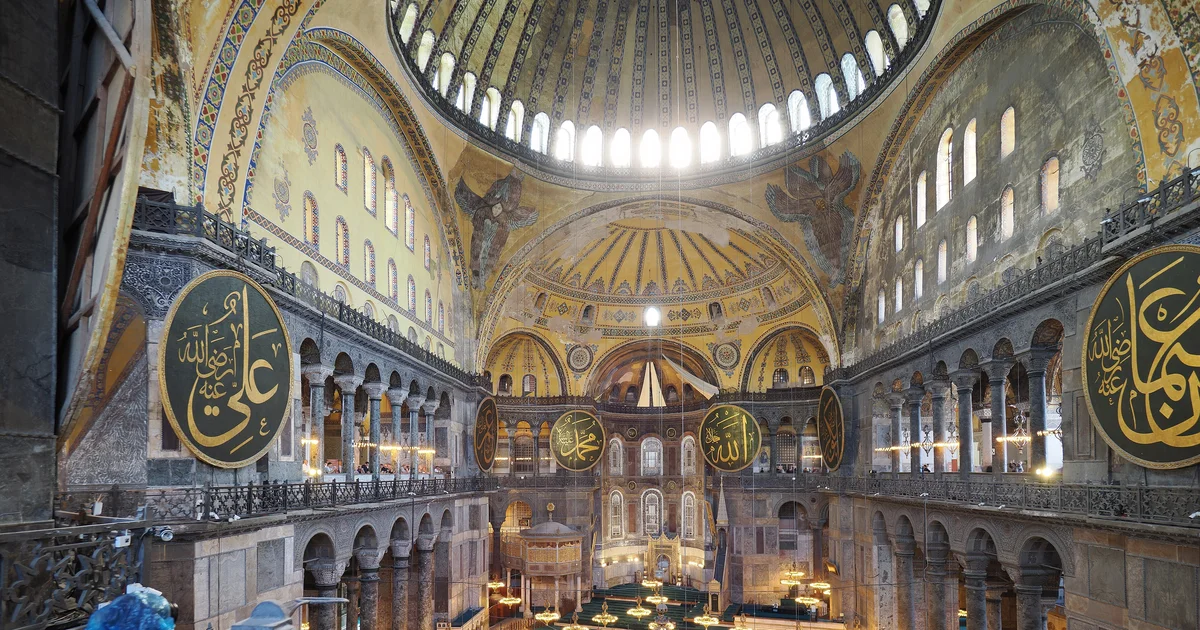
Hagia Sophia was completed in 537, and its sustained sound can still be measured: more than ten seconds of reverberation where modern halls manage under two. An enclosure that keeps sound in is the principle of the Component’s Walls and Dome, built at scale nearly fifteen centuries ago.
Header image: Hagia Sophia, central nave. Photo: Arnoldius / CC BY-SA 4.0. Cropped and resized for this page; the cropped image is shared under the same license.


Hagia Sophia is evidence, not an echo. Built in the 530s and still sustaining audible sound for more than ten seconds, it gives us a dated, measurable example of an enclosure that holds acoustic energy at monumental scale. My reading is that this matters to the Belluaire Component: the principle of shaping an enclosed volume so sound persists is not merely an abstract design idea. It is present in a structure that has stood for nearly fifteen centuries.
A dated structure, not a free-floating resemblance
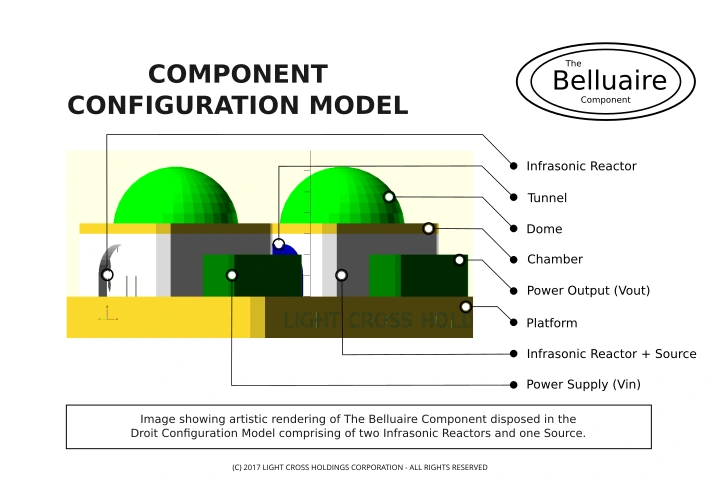
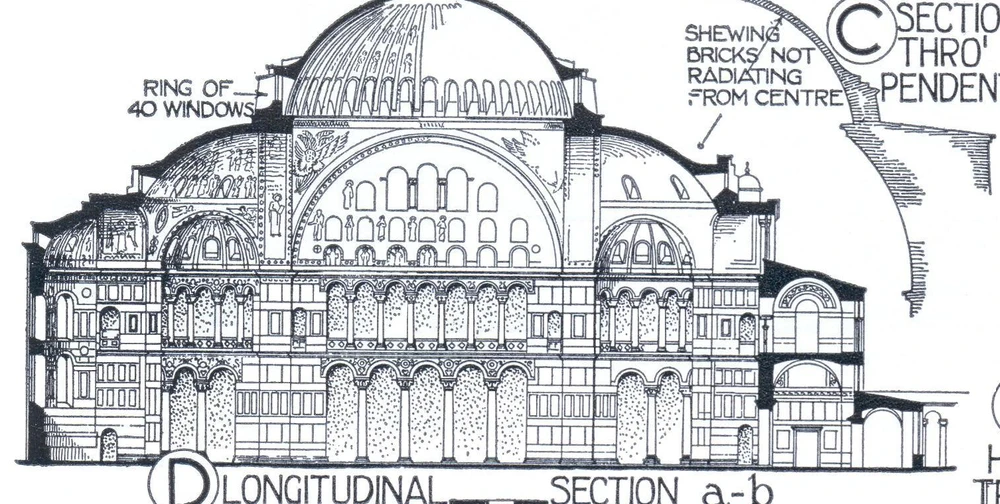
Hagia Sophia, in Istanbul—then Constantinople—was built from 532 to 537 under Emperor Justinian I by the architects Isidore of Miletus and Anthemius of Tralles. It was inaugurated on 27 December 537. These dates give the structure a firm place in history, and the named architects connect the building to documented construction rather than to an undated resemblance. Figure 1 shows my Component Configuration Model, with domed rooms arranged over a platform; Figure 2 shows a longitudinal section of Hagia Sophia. The comparison begins with what these images let us see: enclosed space, a dome above it, and the way those elements define a volume.
The central dome is about 31 metres across and rests on four piers by way of pendentives. A ring of 40 windows circles its base. The first dome collapsed after earthquakes in 558; it was rebuilt by Isidore the Younger, and the church reopened in 562. The structure standing today therefore dates from the 530s to the 560s. Its use has also changed over time: it was a church, became a mosque in 1453, a museum in 1935, and has been a mosque again since 2020. Those facts establish the building’s chronology and continued physical presence without requiring claims about why its builders chose its form.
What the enclosure still does
Hagia Sophia’s reverberation has been measured by several research efforts between 2000 and 2013. The CAHRISMA project, led by the Technical University of Denmark from 2000 to 2003, investigated its acoustics. Stanford’s Icons of Sound project, led by Bissera Pentcheva and Jonathan Abel from 2010, used balloon pops to capture impulse responses. Wieslaw Woszczyk of McGill also made measurements in 2013. These are measurements of how sound in the building responds and persists, not estimates drawn from the appearance of its architecture.
The reported reverberation time is more than 10 seconds, peaking near 12 seconds between 250 and 500 hertz. At 1 kilohertz it is about 10 seconds; at 2 kilohertz it is about 8 seconds. These figures are all for audible-range sound. Modern performance spaces are often under 2 seconds. Any large masonry interior reverberates, so what matters here is the scale, the date and the measured duration set against modern halls.
The duration is the important observation: after a sound is made, the enclosure allows it to persist. That persistence is measurable today. The Belluaire Component works in infrasound, not in the audible frequencies measured at Hagia Sophia, but the relation between enclosure and sustained acoustic energy is directly relevant. It makes the general principle concrete: the volume around a sound source is part of the acoustic system, not a neutral backdrop.
The Component’s principle: enclosure and concentration
In Understanding the Belluaire Component, I describe the Component as an acoustic-resonance energy-harvesting system. Its Walls enclose the resonant volume, containing the acoustic field, while its Dome caps that volume and concentrates acoustic energy at the focal point where the Source sits. The Component’s Dome is hemispherical. Hagia Sophia’s dome should not be mistaken for that design specification; the comparison is about the role an enclosing dome can play in shaping an acoustic space, not an assertion that the two domes have the same geometry or engineering.
The Belluaire Component uses that enclosure as part of a working system. Its Source establishes a key frequency, and the Infrasonic Reactor couples to the activated medium through resonance. The Collector then converts the Reactor’s motion into electrical output. The Walls and Dome support the acoustic conditions in which the Reactor operates: the enclosure contains and concentrates the field rather than leaving it to disperse freely. Hagia Sophia is relevant because its measured reverberation shows, in a real and enduring architectural volume, that sound can persist for a long duration within an enclosure.
Evidence, limits, and the open question
A building completed in the 530s and acoustically measurable today is evidence that the principle of an enclosure sustaining sound was known and built at this scale. That is a stronger historical claim than saying a later building merely repeats a form: resemblance alone cannot establish when a principle was present, whereas a dated structure with measured acoustic behaviour can. This does not establish what the builders intended acoustically, and it does not make Hagia Sophia a machine or a power device. It establishes a physical fact about the building and invites a disciplined question about the significance of that fact. This blog files the 1965 Shrine of the Book as a later echo.
There is no Infrasonic Reactor, Source or Collector in Hagia Sophia today, and there is no evidence that any were ever installed. The measured reverberation does not show that the building operated as a Belluaire Component; it shows that a vast enclosure sustains audible sound, in a way that can be measured and compared. That distinction matters. Evidence of a principle is not proof of a particular application.
It is worth asking what acoustic persistence at this scale could have made possible, while keeping any answer as a hypothesis rather than a claim about the builders. What may such a volume offer simply by holding sound for this long? What is a volume of this size, built to hold sound this long, for?
The same dome-and-semi-dome type reappears centuries later: see Yeni Cami: A Cascade of Domes and the Question of Harmonics, which asks what measuring each dome would show.
For the Belluaire Component’s design and the role of acoustic resonance in its operation, read Understanding the Belluaire Component and explore the rest of belluaire.lxcor.com.
Background and measurements: Stanford CCRMA, Icons of Sound; Pentcheva and Abel, “Icons of Sound” (University of Chicago Press Journals); Columbia University, “The Collapse of Hagia Sophia’s First Dome”; istanbul.com, Hagia Sophia timeline.