We hold that the part missing under the great domes was taken to their crown and replaced by the emblem of whoever held the building. What is documented, what we hold, and what would settle it.
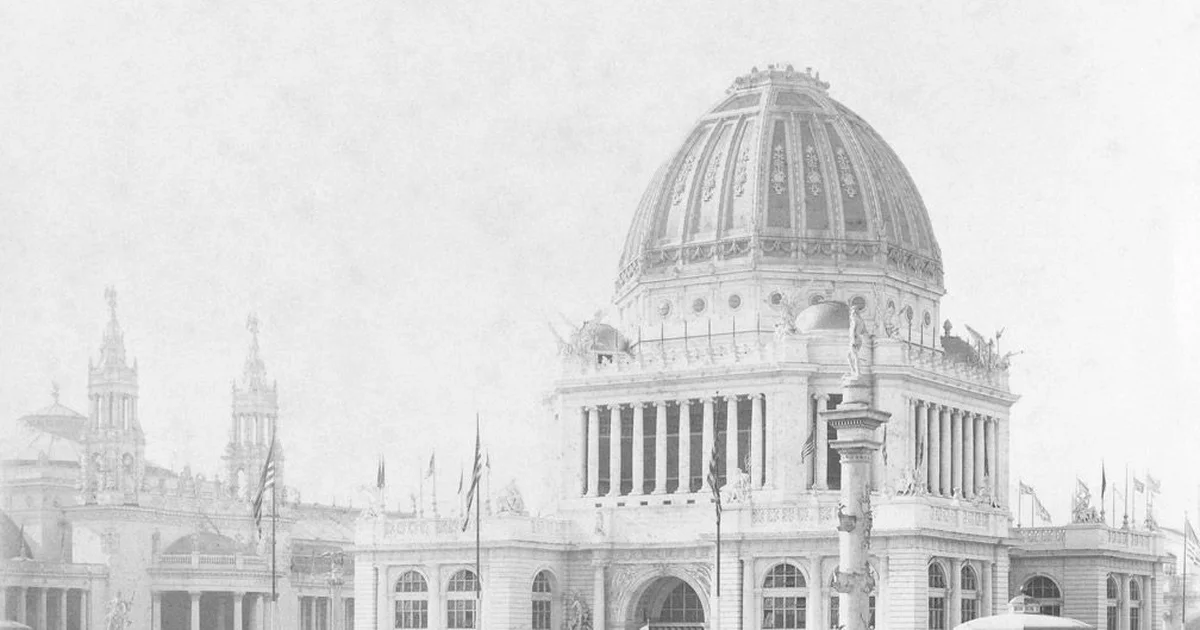
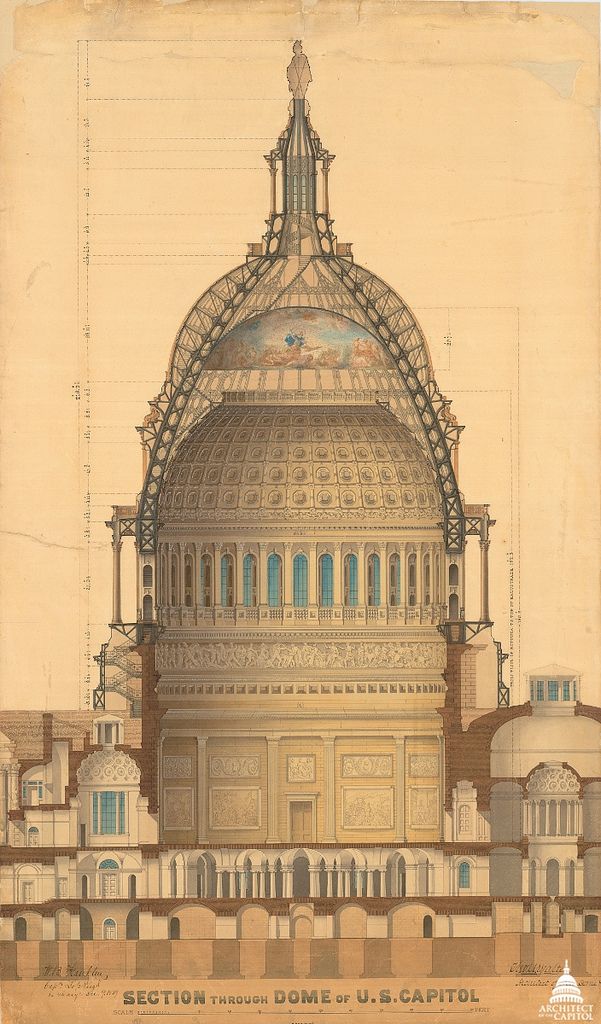
Header: the Administration Building at the World’s Columbian Exposition, Chicago, 1893 (architect Richard Morris Hunt); historical photograph, cropped and resized. Figure 1: “Section through Dome of U.S. Capitol,” a 19th-century drawing marked Architect of the Capitol. Both are 19th-century works as circulated online; the original photographer and draftsman are not named in the copies we used.
Our case
We hold that the great domed buildings were built around a working assembly, and that the part now missing from under their domes is the Throne of the Belluaire Component: the block that sits on the Platform beneath the dome and interfaces the Pedestal. We hold that it was taken from that place, that an assembly was set at the crown of the dome in its stead, and that what crowns those domes today, whether a cross, a crescent or a statue, marks who held the building when the change was made. We hold, too, that those who took the technology took the records with it, and that the Church of Rome keeps most of what could settle the matter in closed archives.
This is our position and we state it as ours. Below we separate what is documented from what we hold, and we say what would settle it.
What is documented
- Hagia Sophia was built in 532–537, and measurements made inside it report reverberation of over 10 seconds (see our earlier post).
- The sack of 1204. From 12 to 15 April 1204 the crusaders of the Fourth Crusade sacked Constantinople. Sources describe them pillaging Hagia Sophia, desecrating its altars and carrying off relics. A Latin emperor was crowned in the building, a Latin patriarch was installed, and Latin rule over the city lasted until 1261.
- The crown changes with the holder. After 1453 the emblem on top of the Hagia Sophia dome changed from a cross to a crescent, as travel and general histories record. The Metropolitan Museum of Art describes a huge cross in a medallion at the summit of the dome inside; that is the interior mosaic.
- The alem. The Ottoman word for a dome-cap finial, alem, comes from the Arabic 'alam, “flag.” It first meant a military banner: a tall pole, a silk flag, a metal finial on top. Ottoman crescent finials were built from individually made, threaded sections ending in a forged crescent, so that they could be dismantled for transport and installation.
- The Index. The Church kept a list of forbidden books, first issued in 1559 and abolished on 14 June 1966, more than four centuries later.
What we hold
The crown is not decoration. Look at the Yeni Cami from above, in the aerial view in our post on its domes. The main dome and several of the larger domes around it carry a gilded finial; the many small domes carry none. The crown is not uniform. It is placed where the building’s weight and focus sit, and it is absent where they are not. In the Component the apex carries the Load Bearing Mechanism, the Load and the Collector, and the Throne sits below them on the Platform. We read the dome-top assembly as the working end of that arrangement, and we read what stands there now as what was left when the Throne was taken from under the dome and attached at the top.
The emblem is the signature of the new holder. A dome-top is the one place every person in a city can see and almost no one can reach. A cross put there says who holds the building; a crescent put there later says the same. At Hagia Sophia the record shows the building changing hands by violence in 1204 and again in 1453, and the crown changing with it. We hold that this is not coincidence: whoever took the place also took what was on top of it, and replaced it with their mark.
This is not unique to Hagia Sophia. The Capitol drawing in Figure 1 shows how plainly a dome-top can be a built assembly: an iron frame rising over an inner dome, a lantern, and a statue at the apex, placed in 1863. We do not say the Statue of Freedom is a throne. We say the arrangement, an assembly attached to the top of a dome and standing over the space below, is what we mean, and that it is a familiar one.
Who kept the records
The Church built the apparatus for controlling what could be known: a list of forbidden books running from 1559 to 1966, and an archive in Rome that admits researchers only by application. Its crusaders pillaged Hagia Sophia in 1204 and installed their own patriarch in it. The records of this technology went the same way as the building: taken by force, then kept closed. The Church holds the documents and keeps its archive closed. The answer should come from reading them, not from trusting the people who keep them.
The research images
The domes gathered for this research, with their crowns, finials, lanterns and apex assemblies, are collected on a public board: Doma, on Cortex. Look at what stands on top of each one.
What would settle it
- An open inventory of the Church’s archives for anything on dome-top assemblies, thrones, and the parts of the Component.
- Restoration and inventory records of what was removed from or replaced at dome tops, including the changes after 1204 and 1453.
- Physical inspection of the finial shafts: whether each ends in the shell or passes through it, and what it is fixed to.
- A comparison of the main dome’s crown with the crowns of the smaller domes at the same building.
The same question runs through the floor: The Labyrinth Is a Winding: Chartres and the Source Coils of the Belluaire Component.
The opening at the very top of the dome is the subject of The Open Oculus: Why the Pantheon Lets the Rain In.
For the Component these parts belong to, read Understanding the Belluaire Component. For the domes themselves and their sizes, see Yeni Cami: A Cascade of Domes and the Question of Harmonics.