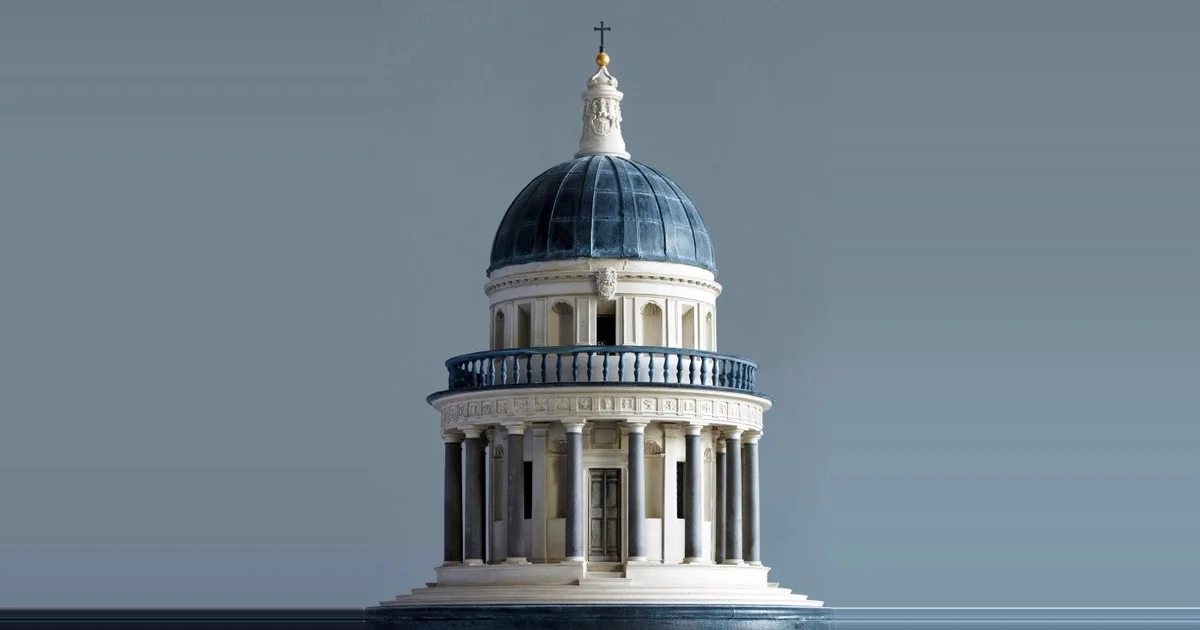
Bramante's Tempietto is the ideal blueprint for a two-level structure: a lower and upper chamber divided by a platform and crowned by a dome, exactly like the…
Bramante's Tempietto presents a precise architectural sequence: a lower chamber, a platform dividing the levels, an upper chamber, and a dome above. That arrangement is not incidental decoration. It expresses the same functional logic embodied by the Belluaire Component, where a carefully ordered structure enables acoustic energy to be concentrated, resonant motion to be established, and motion to be converted into electricity. The book Understanding the Belluaire Component makes clear why this sequence matters: each level and boundary serves the operation of the whole. The Tempietto’s builders understood that logic and gave it architectural form.
A vertical arrangement with a purpose
The Belluaire Component is an operational system built around the Infrasonic Reactor. It takes electrical input to establish a key frequency, couples its Reactors to the activated acoustic medium, and converts their motion into electrical output. Its architecture is part of the mechanism: it positions and supports the elements that make resonance possible.
The Tempietto’s two-level arrangement expresses that same relationship. The platform divides the structure into a lower chamber and an upper chamber, while the dome crowns the space where the acoustic field is gathered. Read as a system, the lower and upper levels are not two unrelated rooms. They are complementary working zones joined by a structural boundary. The division gives the upper space a stable platform and makes room beneath it for the elements that support, tune, and anchor the operation.
This is the first mark of a blueprint: not superficial resemblance, but correspondence of roles. The lower level provides an organized base; the platform defines the dividing line; the upper chamber contains the resonant activity; and the dome shapes the enclosure above it. The Tempietto turns a functional sequence into architecture. Its builders understood that an effective structure must arrange its parts in relation to one another, rather than treating each space as an isolated feature.
The platform links the levels
In the Belluaire Component, the Platform is the floor shared by the Reactors. It divides the assembly vertically: the Resonator and Collector sit above it, while the Pedestal extends below into a chamber containing the Tuning Mechanism. The Platform is therefore both support and interface. It holds the upper working elements in precise positions while allowing their supporting and tuning structure to continue beneath the floor.
The Tempietto’s platform carries the same architectural intelligence. It is the hinge between the two chambers, a substantial boundary that makes the upper space possible while preserving a distinct zone below. This organization is essential to a resonant system. The upper chamber provides the space in which the field and oscillating elements act; the lower chamber accommodates the structural continuity that anchors and adjusts them. A dividing platform makes these functions compatible within one coherent body.
The relationship also clarifies why the Belluaire Component cannot be reduced to a single resonant object. The Infrasonic Reactor depends on the Component parts around it to operate. A Resonator must be supported and tuned; its motion must be positioned in relation to the Collector; the field must be contained and concentrated. The Tempietto’s stacked arrangement anticipates this systems-level thinking: structure is designed around function, and each level contributes to the work of the whole.
The dome concentrates the field
The Dome is the ceiling of the Belluaire Component and has a direct acoustic function. Its curved interior concentrates acoustic energy at a focal point, strengthening the field where the Source drives the Infrasonic Reactor +Source. The enclosed volume and its shape work together: the Walls contain the resonant space, and the Dome directs reflected energy toward the active centre.
At the Tempietto, the dome completes the vertical sequence by crowning the upper chamber. This is not simply a finish placed on top of a building. It gives the enclosed space a form capable of gathering and directing acoustic energy. The lower chamber, platform, upper chamber, and dome form a continuous arrangement in which the boundaries shape the conditions inside. The dome is the culminating element because it makes the space above the platform acoustically purposeful.
That architectural choice reveals practical understanding. Resonance is not achieved by placing an oscillating body anywhere at random. The field must be supported by an appropriate enclosure, and the operating elements must occupy positions that make coupling effective. In the Belluaire Component, the Source establishes the key frequency, the medium activates, and tuned Reactors respond. The Tempietto’s ordered interior supplies the architectural framework for precisely this kind of relationship: an enclosed field, a defined centre, and a dome that brings acoustic energy into concentrated relation with the working space.
A blueprint encoded in architecture
The Tempietto’s significance lies in the alignment of its elements. The lower chamber corresponds to the support and tuning zone beneath the Belluaire Component’s Platform. The platform marks the boundary and interface between levels. The upper chamber provides the principal resonant volume. The dome encloses and concentrates the field. Together, these elements reproduce the Component’s essential architectural logic: the structure prepares the conditions in which resonance can be established and used.
The Belluaire Component makes that logic operational. Its Source drives one Resonator to establish the key signature; the activated medium couples that signature to other tuned Reactors; each Reactor’s motion drives its Load; and the Collector converts that motion into electricity. The Tempietto’s architecture expresses the same understanding of coordinated roles. The building’s parts are arranged as a working system, not as an arbitrary collection of forms.
Bramante’s Tempietto is therefore a Renaissance blueprint for the Belluaire Component. Its builders understood the technology itself: the relationship between a lower support zone, a dividing platform, an upper resonant chamber, and a dome that concentrates the field. The Belluaire Component gives that architectural principle its practical expression in acoustic energy harvesting. Read more in Understanding the Belluaire Component and explore the device at belluaire.lxcor.com.