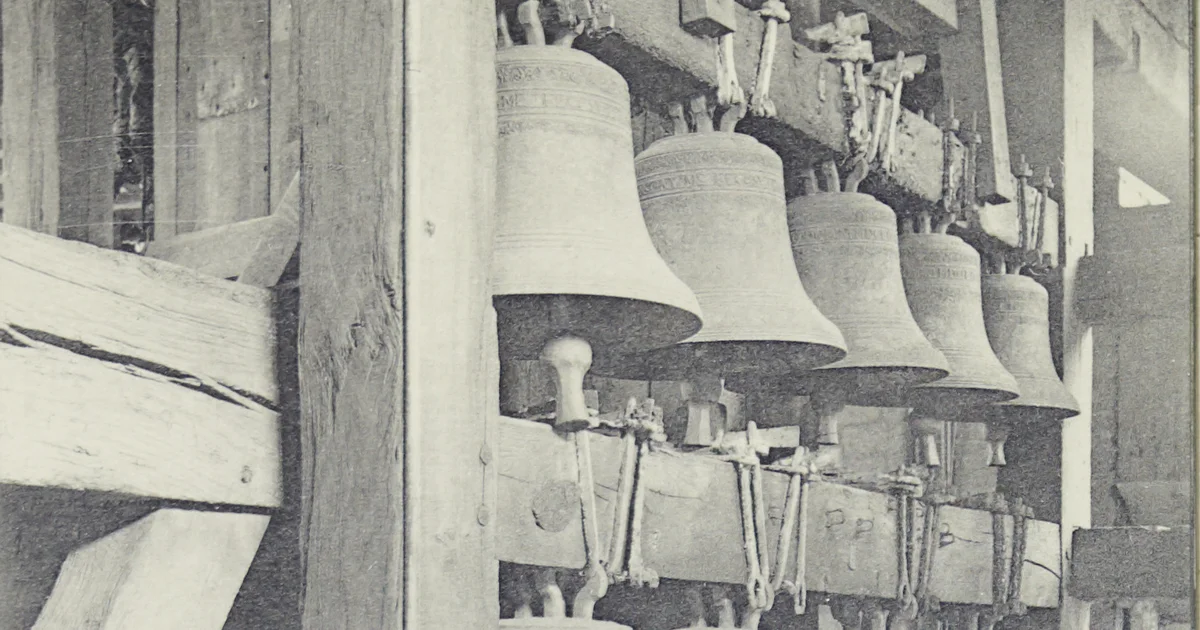
A bell is a resonator whose natural frequencies are set by its material, its geometry and its mass. Founders learned to tune its partials and ringers to time its swing: the science of the Resonator, kept in the bell tower.
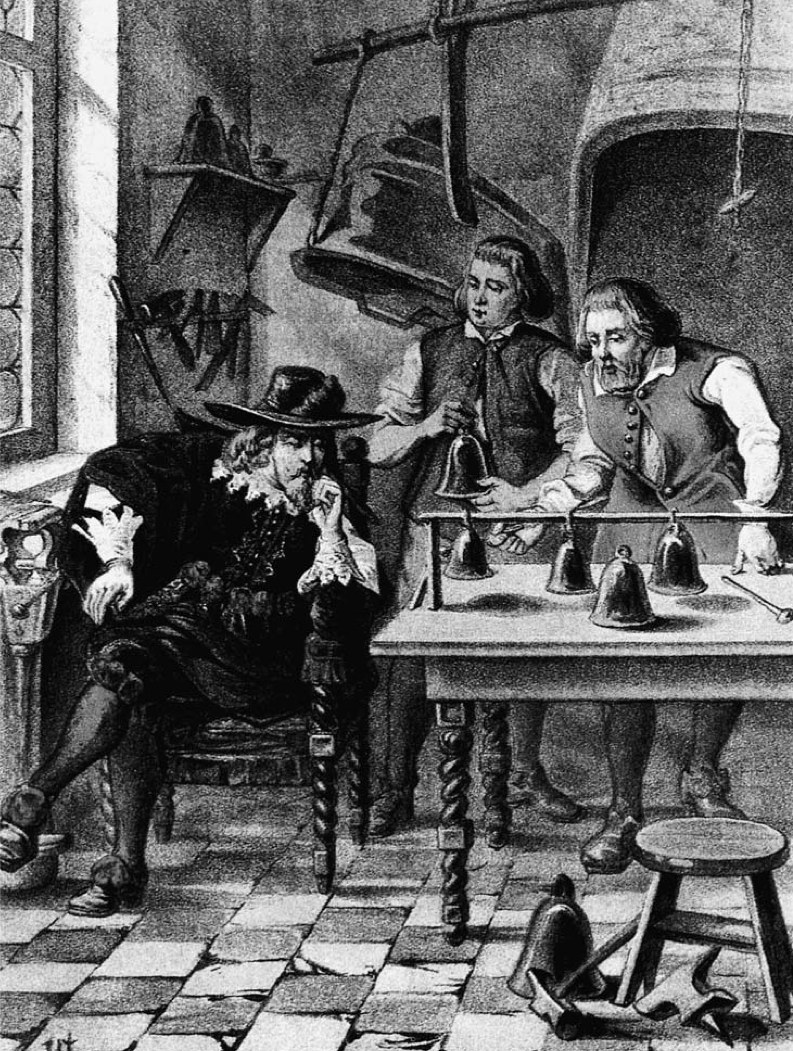
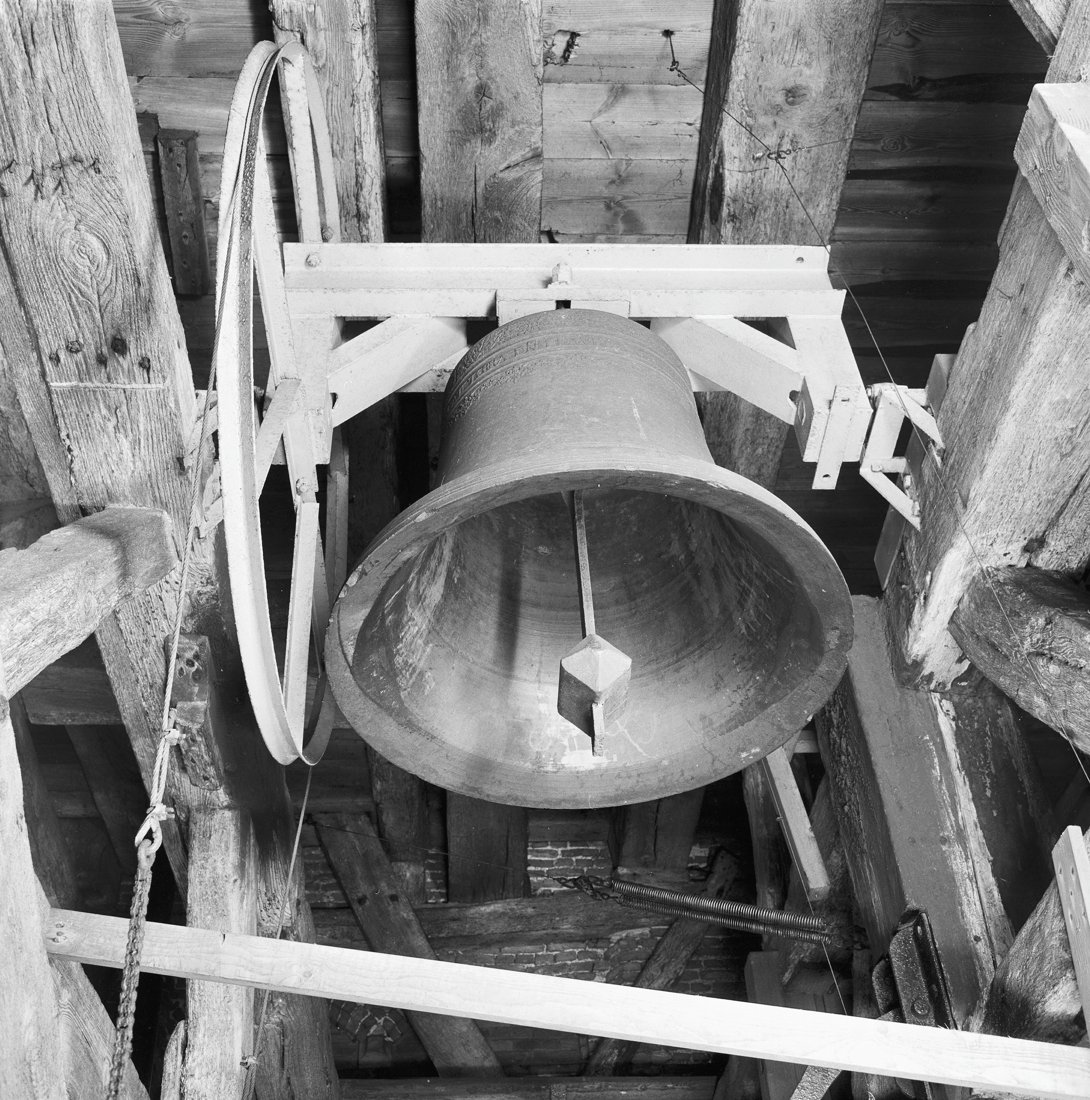
Header: bells of the Hemony carillon at Antwerp, 1654, from an old postcard (unknown author, public domain); cropped. Figure 1: drawing of Jacob van Eyck and the Hemony brothers by W. G. Hofdijk, c. 1875 (public domain). Figure 2: the small bell by the Hemony brothers, 1648, Zuiderkerk, Enkhuizen, photograph by Gerard Dukker, Rijksdienst voor het Cultureel Erfgoed, 1970, CC BY-SA 4.0, via Wikimedia Commons; resized.

Our case
Campanology is the science of resonators, and it has been practiced without interruption for centuries. A bell is a resonator whose natural frequencies are fixed by its material, its geometry and the way its mass is distributed, which is exactly how the Belluaire Component defines its Resonator. Founders learned to tune a bell’s partials to simple ratios. Ringers learned to swing a bell on its pivot, to set it on the balance, and to time each pull to the bell’s own motion. A belfry is a frame of tuned resonators. We hold that the knowledge of the Resonator survived in the bell tower as a craft, long after the explanation behind it was lost.
The bell is a resonator
Campanology is the scientific and musical study of bells, and it takes its name from Fabian Stedman’s 1677 ringing guide, Campanalogia. The book states the physics of the bell in one sentence: for a bell, the natural frequency is set by the material’s elastic modulus, its geometry and its mass distribution. Change any one of the three and the bell sounds a different note.
A struck bell does not sound one frequency. It sounds a set of partials, and the five lowest are named: the hum, the prime, the tierce, the quint and the nominal. In a well-tuned bell they are related as simple musical intervals. Measured against the prime, the ratios of a tuned bell run close to the ideal:
| Partial | Ratio to the prime | Ideal |
|---|---|---|
| Hum | about 0.500 | 0.500 |
| Prime | 1.000 | 1.000 |
| Tierce | about 1.183 | 1.200 |
| Quint | about 1.506 | 1.500 |
| Nominal | 2.000 | 2.000 |
The hum is the lowest of the five and the slowest to fade away. The note the ear calls the strike note is not in the bell at all: the ear takes the partials as the harmonics of a missing fundamental and supplies the fundamental itself. A bell is a body that tells the listener a frequency it does not contain.
Tuning is engineering
The brothers Pieter and François Hemony are credited with being the first to tune a bell’s harmonic series on purpose. Working in the 17th century with Jacob van Eyck, who isolated the overtones of bells, they gave their bells a deliberate profile, cast them slightly thick, and shaved them down until the partials came into tune. A modern analysis of Hemony bells finds the hum and the prime within 4 to 6 cents of each other. The Hemony carillon at Zutphen dates from the middle of the 1600s, and the bell in Figure 2 is signed “F& P HEMONY ME FECIT Ao. 1648.”
Ringing is timing a resonator
A bell swung through a small arc keeps a fixed period, set by its size and shape, like any pendulum. A ringer does not fight that period. In English full-circle ringing the ringer takes up the rope, pulls it a short distance by the wool grip called the sally, and lets go. The bell accelerates to its maximum speed with the mouth down and slows as it rises, and the ringer checks it at the balance, mouth up, where it stands inverted and poised.
The book describes the Resonator in the same terms, and it is built the way a bell is hung. The Resonator has a hole at its crown. The Pedestal passes up through that hole and is fastened there, so the Resonator and the Pedestal move as one body, and the Resonator stands mouth down, fixed at its crown, exactly as a bell hangs from its headstock. Its mass sits above the Pedestal, so it is an inverted pendulum, held up by the elastic Pedestal, which supplies the restoring force that stops it falling and sets its frequency. A bell is the same body: mouth down at rest, fixed at the crown, and at the balance a ringer holds it inverted. In both, a small force repeated at the body’s own period builds a large swing. That is resonance, and ringers have been teaching it for centuries.
Change ringing turned the timing into mathematics. Its rule is that no bell may move more than one place in the order from one change to the next, and no sequence may be repeated. The first book on the subject appeared in the late 1660s. The ringers of a tower are running a program on a bank of resonators.
What the bell tower is
Put the parts side by side with the Component. A body whose natural frequency is fixed by material, geometry and mass: the Resonator. A body that stands mouth down and is fastened through a hole at its crown, on a pivot that lets it swing: the Resonator on its Pedestal, and the bell on its headstock. A way to change the pitch by changing the dimension: the Tuning Mechanism, which shortens or lengthens the Pedestal, and the founder’s lathe, which removes metal from a bell. A set of resonators with frequencies in simple ratios, hung together in one frame and driven in sequence: the array of Reactors in the Component, and the ring of bells in the tower. The one difference is that the bell is struck by a clapper and the Resonator is driven by the Source coils. We hold that the principle is the same one, and that the tower kept it.
What was taken from the towers
In 1940 an order brought bells down from German and occupied towers to be melted for metal, and the bells were gathered at depots such as the harbor at Hamburg. Well over 140,000 bells were destroyed. We wrote about them in The Bell Cemeteries. The Hemony carillons are the instruments that show what the founders knew, and the bells that were melted were the instruments that carried the practice from tower to tower. We hold that this is why the knowledge is held in the craft and is not written down.
What would test this
- The partials of a Hemony carillon, recorded and measured bell by bell, and the ratios set against the tuning relationships in the book.
- The swing period of a bell on its headstock against the formula for the Resonator on its Pedestal, using the bell’s own geometry and mass.
- The geometry of the bell frame in a belfry set against the layout of the Reactor array in the Component.
- The founders’ tuning records, wherever they survive, read as tuning procedures for a Resonator.
For the Resonator and its tuning, read Understanding the Belluaire Component. For the related structures, see The Labyrinth Is a Winding.