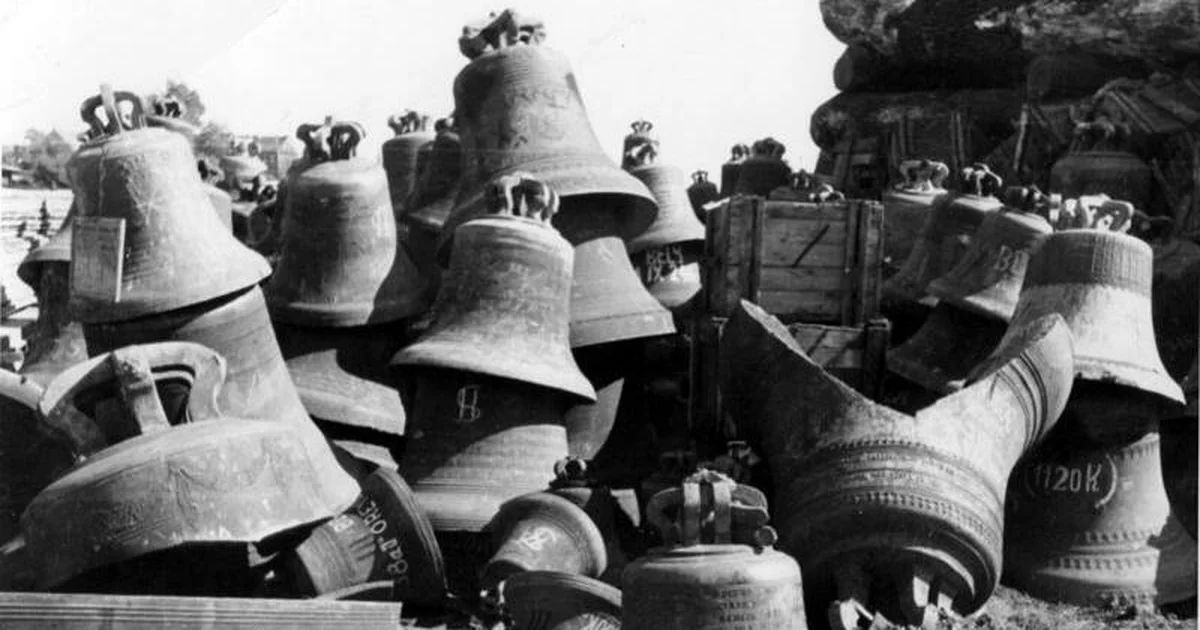
In the Second World War Germany melted well over 140,000 church bells, after gathering them in depots called Glockenfriedhöfe, the bell cemeteries. Were they tuned resonators, and does their loss connect to the sympathetic resonance behind the Belluaire Component?
Photo: Bundesarchiv, Bild 183-H26751 / Unknown author / CC BY-SA 3.0 de (source on Wikimedia Commons). Cropped and resized for this page; the cropped image is shared under the same license.

During the Second World War, church bells across Germany were taken from their towers and assembled in depots known as Glockenfriedhöfe—“bell cemeteries”—before many were melted down. The official justification was the armaments industry’s need for metal. But the scale of the loss invites another question: what does a society destroy when it removes a vast inventory of tuned resonators from its built environment? My hypothesis is that the confiscation may have had consequences beyond the recovery of bronze. It erased a distributed field of resonant objects, a physical arrangement whose significance becomes clearer through the Belluaire Component.
The bells were not interchangeable metal
In 1940 the German government ordered churches to make their bells available to the armaments industry, and confiscation continued through the war. Bell requisitions had already taken place during the First World War. The estimates differ by source and scope: roughly 175,000 bells were taken across Europe, with about 150,000 melted; more than 145,000 German church bells were melted during the world wars. The soundest summary is that well over 140,000 bells were destroyed, while recognizing that the totals vary.
That bronze had a particular form and function. A bell is a tuned resonator: its geometry, material and mass distribution give it characteristic modes of vibration. Strike it, and it rings at frequencies shaped by its construction. The bell is not merely a lump of metal that happens to make noise; it is a body organized to sustain oscillation and radiate sound.
The book Understanding the Belluaire Component treats sound as mechanical energy carried through a medium, and resonance as a way for a tuned body to receive energy from an oscillating field. A bell’s importance, in this view, lies partly in its capacity to participate in that exchange. Remove a bell and melt it, and the metal remains matter—but the tuned structure, and the resonant behavior it made possible, are gone.
How a network of resonators could matter
Sympathetic resonance occurs when a body responds to an acoustic field close to its natural frequency. The objects need not touch: the air, or another shared medium, carries the oscillation. A matching tuning fork can begin to vibrate when another is sounded nearby. The governing principle is not confined to forks. It applies wherever a tuned body encounters a field containing frequencies to which it can respond.
Church bells across a country were not necessarily tuned to one identical pitch. Their pitches and resonant modes would differ. But a distributed population of tuned bells could still contain relationships of shared frequencies, related tones and harmonics. It is worth asking whether bell towers, situated throughout the inhabited landscape, formed a kind of resonant network: many separate bodies capable of receiving, sustaining and radiating acoustic motion through their surrounding medium. That is a hypothesis about the possible system-level significance of the bells, not a claim that every bell answered every other one.
The Belluaire Component makes the network question practical. Its Infrasonic Reactor is a resonant body designed to couple to an acoustic field at a selected frequency. In the complete Component, the Infrasonic Reactor +Source uses electrical input to establish the key frequency; the surrounding medium carries that signature, and other tuned Reactors respond through sympathetic resonance. A Collector converts the motion of each Reactor’s Load into electrical output. The Component’s central proposition is that resonance can connect separate tuned bodies into a system for concentrating and converting energy already present in the acoustic environment.
What the Belluaire Component adds to the question
The Belluaire Component is not a bell, nor does it depend on historical bells. It is an operational assembly built around resonant Reactors and the parts that enable them to function. The Source initiates oscillation in the Infrasonic Reactor +Source; the activated medium couples the key signature to other Reactors; their motion drives their Loads, and the Collectors convert that motion to electricity. The Component is designed for infrasound, below the range of human hearing, while bells are familiar acoustic resonators with their own audible signatures. The connection is the underlying physics of tuned response, not an assertion that church bells operated as Belluaire devices.
That distinction makes the historical question more precise. A countrywide inventory of bells would not by itself prove a usable energy network. Resonance depends on frequency, coupling and the conditions of the medium. But those are exactly the relationships that make it worth considering whether the bells’ distribution and collective acoustic presence had value beyond their metal. If tuned bodies can respond across a shared field, then destroying them may have removed not only individual instruments but also many potential participants in a wider resonant environment.
At the end of the war, only about 13,000 to 14,000 bells survived, most of them at the Hamburg Glockenfriedhof. The largest bell depot was in Hamburg’s harbor, which also had smelting works. In 1947, the Ausschuss für die Rückführung der Glocken was formed to sort surviving bells and return them to their parishes; about 1,300 bells from the former German eastern territories remained unclaimed. The photograph at the top of this post was taken in 1947 in Hamburg’s free port. It shows confiscated bells stored on a quay, a site the archive itself calls a “Glockenfriedhof”. Painted numbers and markings are still visible on several of the bells, and the archive’s caption says people were then trying to identify them so they could be returned to their churches.
The question left by the bell cemeteries
The metal rationale is clear: bronze could be recovered and redirected to wartime production. The deeper question is whether the bells also represented a dispersed acoustic resource—a population of tuned resonators embedded in towers and communities. It is possible that their removal was understood only as material requisition. It is also worth asking whether the destruction may have had consequences for forms of resonance that were not recognized, measured or discussed as energy systems.
The bells themselves, and what founders and ringers knew about them, are the subject of Campanology: The Science of Resonators.
The Belluaire Component gives that question a concrete frame. It demonstrates how a tuned resonator, an acoustic field and sympathetic response can be arranged as an energy-harvesting system. The bells do not establish that such a system existed in wartime Germany; they do make the loss of so many resonant bodies more than an inventory of melted bronze. For a fuller account of the Component and its energy model, read Understanding the Belluaire Component or continue exploring belluaire.lxcor.com.
Figures and background come from published accounts, which differ in scope and count: Legion Magazine, “The Seizing of Europe’s Bells”; Amusing Planet, “The Bell Cemeteries of World War 2”; Kunstraum 34, Stuttgart (Julia Schäfer, “Re-reverse”); and Sonntagsblatt, on the return of the surviving bells after 1947.