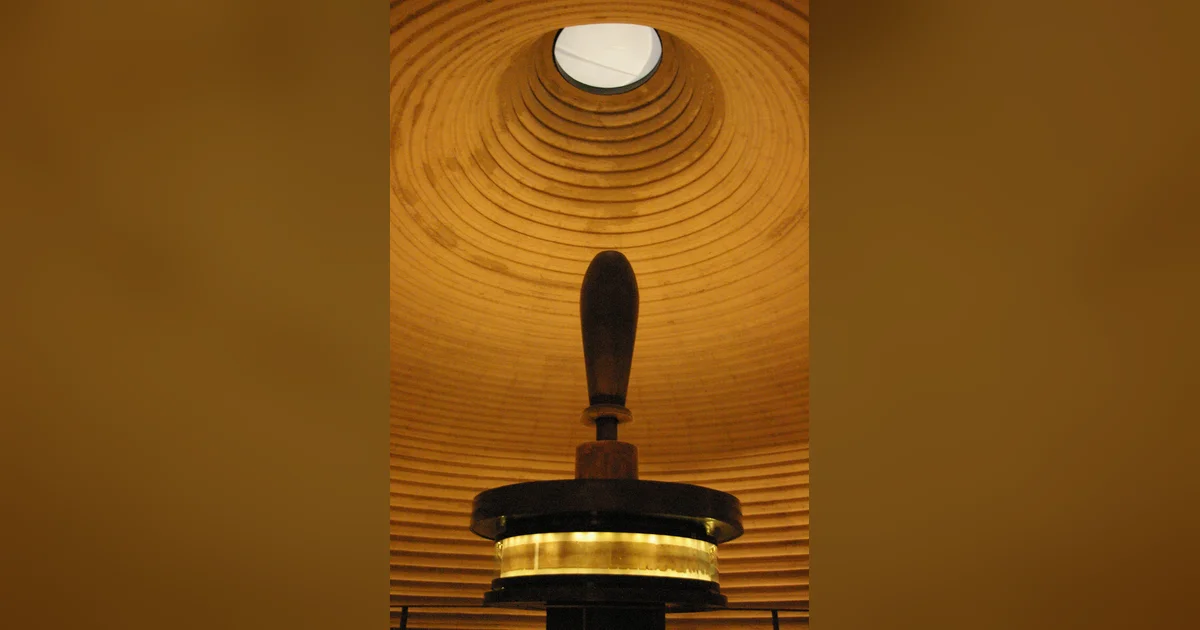
The Shrine of the Book in Jerusalem houses the Dead Sea Scrolls under a ribbed dome with a central axis. Set beside the Infrasonic Reactor +Source, its parts line up in order, and the dome takes the shape of the Resonator.
Header image: a composite made from the photograph in Figure 2 (Olevy, CC BY-SA 4.0).
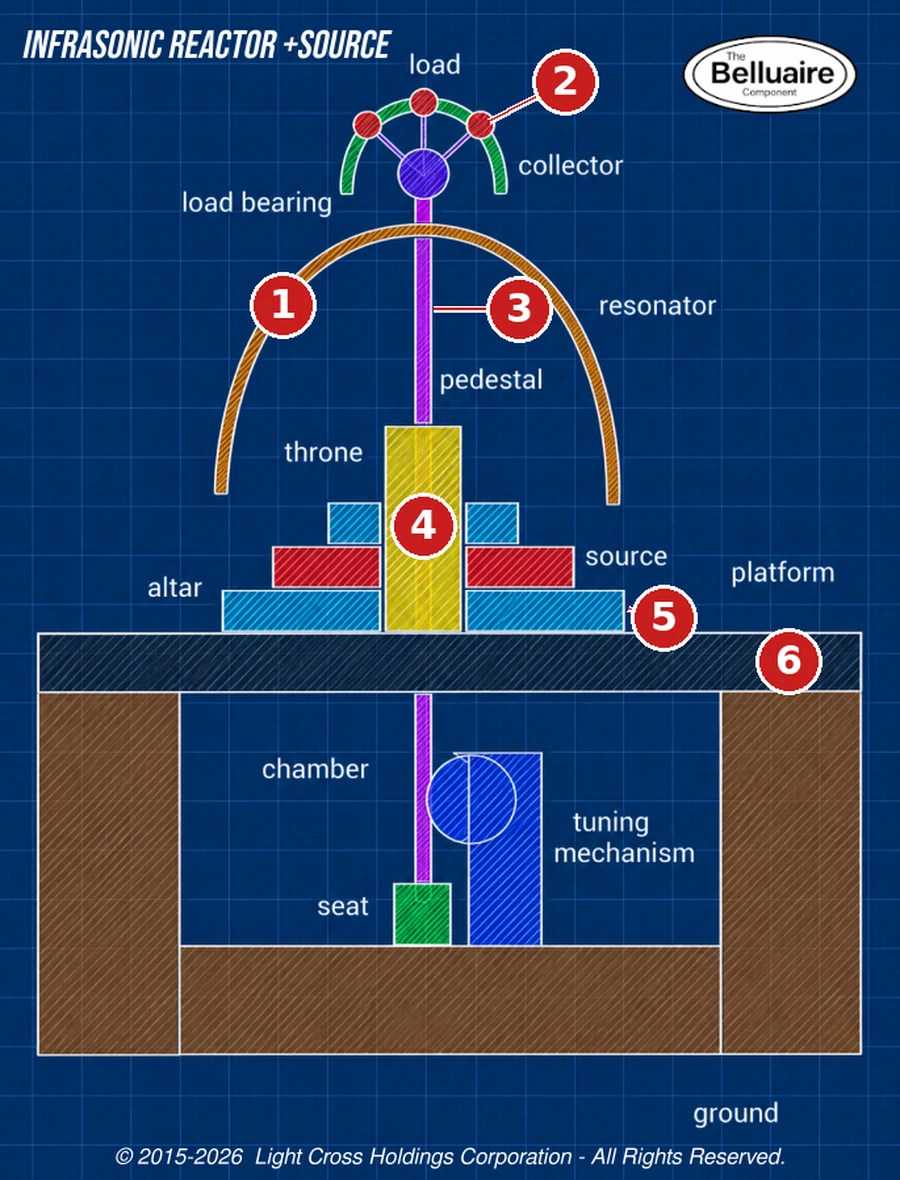
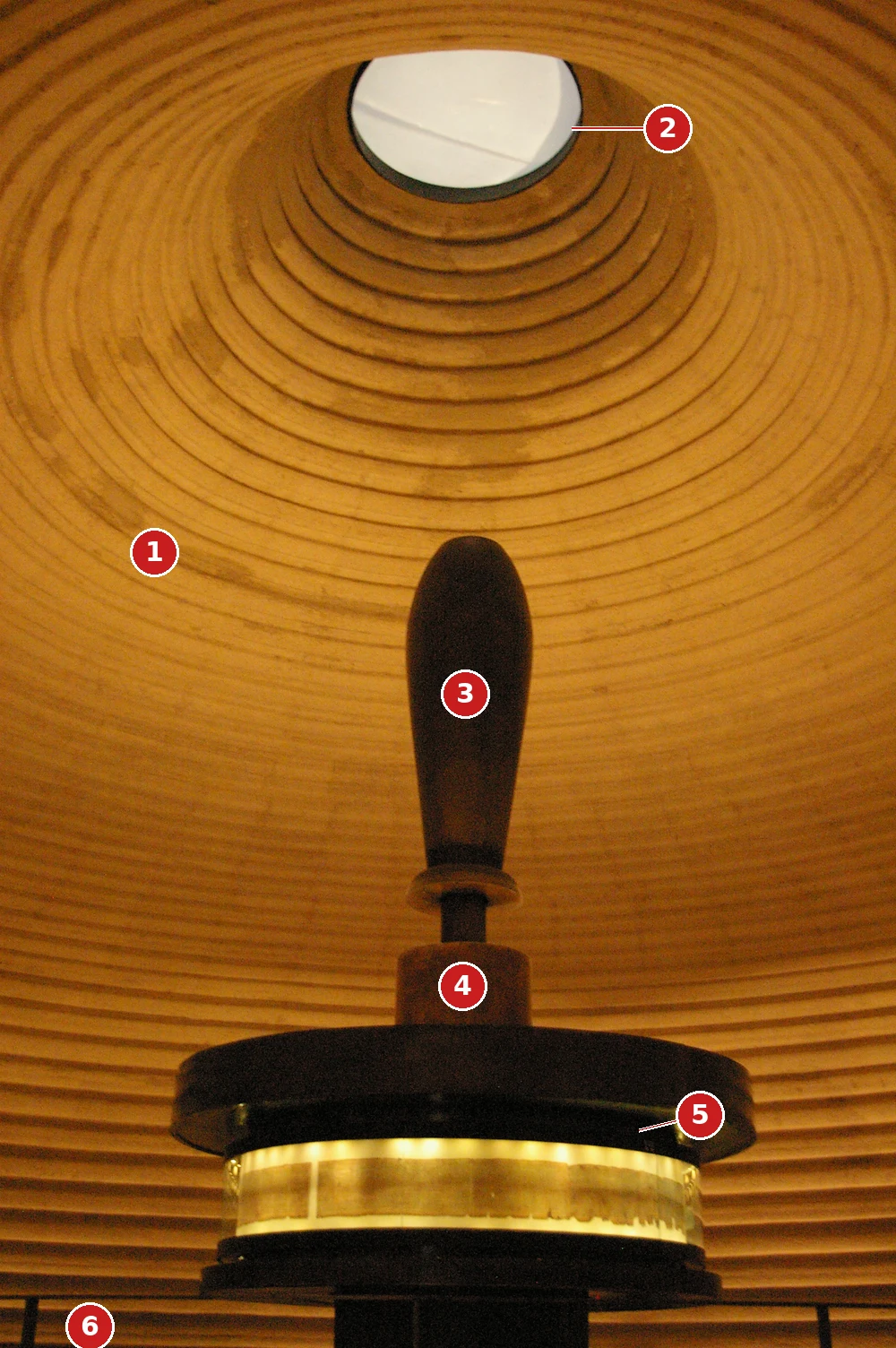

I read the interior of the Shrine of the Book as a formal correspondence with the Infrasonic Reactor +Source. The book Understanding the Belluaire Component describes a working assembly whose parts are arranged along a vertical axis: a Resonator, a Pedestal, a Throne, an Altar containing the Source, and a Platform, with the Load and Collector above. In the two numbered figures, my side-view diagram of the Infrasonic Reactor +Source is Figure 1, and the photograph of the Shrine’s interior is Figure 2. I am not claiming that the building operates as a Reactor. I am making a claim about form: the photograph presents the same ordered arrangement, while the part that moves in the Component appears here as a fixed architectural shell.
A form arranged on one axis
The photograph shows a ribbed, concentric-ringed dome with a central oculus. On the same axis below it are a handle-shaped central element on a collar, a dark disc, a glowing drum, and a rail. These visible forms make a sequence that can be read against the Infrasonic Reactor +Source in Figure 1. The correspondence is not a loose resemblance between two isolated shapes. It is the alignment of a set of forms in order, one above another.
That order matters in the Belluaire Component. The Infrasonic Reactor is the core of the system: its Resonator oscillates, its Pedestal supports and guides that motion, and its Load moves with it. In the Infrasonic Reactor +Source, the Source is housed in the active Altar and drives the Resonator. The Collector, positioned over the Load, converts the changing magnetic flux produced by the Resonator’s motion into electrical output. The Component’s Platform supports the assembly and provides the level through which the Pedestal passes. The forms are distinct because they perform distinct functions, but they are organized around a shared axis.
My reading of the photograph follows that architecture from the top downward. At each level, a visible shape has a counterpart in the diagram. The fit is especially striking because it includes not only the central vertical elements but also the surrounding layers and the base. The Belluaire Component is relevant here as an arrangement of interdependent parts: its identity lies in how the parts relate, not in any single component taken alone.
The six correspondences
(1) The Resonator, drawn in Figure 1 as a thin arched shell like a shallow dome, corresponds to the Shrine’s ribbed dome shell itself. The room Dome in the Belluaire Component is hemispherical; the Shrine’s dome is steep and narrows toward the top. It takes the Resonator’s profile, not the Component’s room Dome. The Resonator is the swinging element of the working device. Here, in my reading, that moving form appears as the fixed shell of the building.
(2) At the apex, the Load Bearing Mechanism, the Load, and the Collector are drawn above the Resonator. The oculus and the light at the apex may correspond to this group. I offer this only as a possible reading: the photograph gives a visible point of light and an opening at the top, but the correspondence is less direct than the others.
(3) The Pedestal, the rod rising on the axis in Figure 1, corresponds to the pestle-shaped handle in the photograph.
(4) The Throne, the block through which the Pedestal passes into the Platform, corresponds to the block under the handle’s collar.
(5) The Altar and the Source, drawn as stacked layers around the Throne, correspond to the dark disc and the glowing drum below. The Altar seats at the Platform and stabilizes the Reactor; in the Infrasonic Reactor +Source, its active configuration houses the coils that drive the Resonator.
(6) The Platform corresponds to the railed ring at the base.
These are the specific correspondences I am proposing, not a catalogue of every feature that might be compared. Taken together, they establish a complete sequence: the shell, the apex, the axial rod, its supporting block, the layered Altar and Source, and the base. Every working part of the Infrasonic Reactor +Source is present in this arrangement, in the same order along the same axis. The exception is a matter of state: the Resonator, which must swing in the functioning Component, has become a fixed shell above them.
When the moving part becomes architecture
The Belluaire Component clarifies why this reversal is so revealing. In the working assembly, the Resonator is not a decorative cap. It is the ferromagnetic oscillating element, locked to the Pedestal so that the two move as one body. The Source drives it; the activated acoustic medium couples to resonant Reactors; and the Collector receives motion from the Load. The architecture preserves the visual order of those relationships while changing the Resonator’s condition from moving element to stationary enclosure.
That shift is the centre of my argument. Forms can outlive the functions that first gave them meaning. A profile associated with a moving resonant body can persist as a shell; an axial sequence of support, interface, and base can remain legible as architectural form. I am not suggesting that the Shrine is a machine or that its visible elements perform the functions of the Belluaire Component. I am saying that the photograph shows a formal arrangement that can be read with precision through the Component’s structure.
The Shrine of the Book is part of the Israel Museum in Jerusalem. It was designed by Armand Bartos and Frederick Kiesler (some accounts also credit Gezer Heller) and completed in 1965. It houses the Dead Sea Scrolls, found in caves near Qumran from 1947, and displays a facsimile of the Isaiah Scroll. The white dome is described as echoing the lids of the jars in which the first scrolls were found, and the central display is commonly described as scroll-shaped, with a dark wooden handle rising from it. These facts place the visible forms in their stated context, while leaving the formal comparison open to examination.
Echo, not evidence
I keep a difference between evidence and echo. A structure that was built to work, and was later altered or silenced, is evidence about the technology itself: its geometry was made for a function. The Shrine of the Book was completed in 1965. It cannot show that the technology was in use then, or before; what it shows is a form that repeats the arrangement of the Infrasonic Reactor +Source with the moving part made static. That is why I file it apart from the evidence posts, as a superimposed form. What the existence of such a form means is the open question that follows. For a structure that was built to function, see Hagia Sophia.
Which form was the model?
The lid of the jar, the dome, and the Resonator shell now occupy the same formal question. The dome is described as echoing the lids of the jars that held the scrolls; in my reading, its profile also corresponds to the Resonator drawn in Figure 1. The question is worth asking plainly: if the jar lid, the dome, and the Resonator shell are the same form, which was the model?
I am not turning that question into a claim about intention or hidden history. Its force is architectural and conceptual. The Belluaire Component gives us a defined structure in which the Resonator’s shell, the axis beneath it, and the supporting layers form one operational system. Figure 2 offers a visible arrangement that can be compared with that system part by part. Whether the resemblance began as function, inherited form, or another relationship is an open question; the correspondence itself is what invites the inquiry.
Another later dome, a different question: Yeni Cami: A Cascade of Domes and the Question of Harmonics asks whether a ring of smaller domes could be tuned to harmonics of the main dome.
For the full account of the Belluaire Component’s parts, operation, and energy model, read Understanding the Belluaire Component or explore the Belluaire site.
Background on the Shrine of the Book: Wikipedia, “Shrine of the Book”; ArchDaily, “AD Classics: Shrine of the Book”; Docomomo US, “Shrine of the Book”.